Calgary City Hall reaching new levels of idiocy on the way to 2013 elections.

While governments on all levels struggle with deficits and tough social challenges, Calgary city hall remains immersed in idiotic navel gazing and pie-in-the sky policies from trying to ban Calgarians from eating certain kinds of soups to closing lanes on roadways to accommodate a demand for bicycle lanes that does not exist.

While many of our city council members are members of the flakey-left, Brian Pincott never fails to take the cake in his stupid, intrusive and rather petty initiatives. Some of his antics have been covered here.

The looming dragon that Pincott is now slaying in city hall is his imagined issue of: LIGHT POLLUTION!

Backed by Richard Pootmans, Councilor Brian Pincott got a motion passed to work towards implementing massive regulatory changes to how we are allowed to light things outdoors.

The document can be found here.  This document is loaded with idiotic terms such as “light trespass” and “unchecked light egress” along with enough other vapid pap that one feels somewhat dumber for having read it.

Bullshit issues abound from “impacts to human immune function” (load of crap) to even worrying about our poor bug population: “behavioural changes in insect and animal ecosystems”.

We have millions and millions of unlit acres in Canada where our mosquitos can live without fear and moths can thrive without running into porch lights.

If left unchecked, busybody nuts like Pincott will have armies of bylaw officers checking everything from whether you packed your coffee grounds in the wrong bin to peeking over your fence to check the wattage of your porch light (assuming you are allowed to have one). This document also suggests that perhaps lights within buildings should be regulated in their use too!!

Yes people, screw emergency services! Who cares about those pothole loaded roads and overflowing sewers! What this city needs is discussion on porch lights, fire pits and coffee grounds!

We are still more than six months away from the municipal elections but the time is now to prepare to change some of the nuts out that we have on council. Pincott only won by default when Barry Erskine pulled his stunt of a last second retreat from the election race leaving no time for any sane candidates to enter and run in Ward 11. Let’s not let this flake (among others) get re-elected to Calgary city council. We can’t afford many more years of this kind of terrible city management.

Calgary police can’t claim to be surprised this time.

Below is the event information for the “Idle No More” protest planned for Monday January 28.

It does appear that the times have changed and rush hour disruption may be avoided


From the South: March northbound on Macleod Trail (meet at Stampede parking lot) 1 pm

From the West: March eastbound on 9 ave (meet at Shaw Millenium park) 1 pm

From the North: March southbound on Centre st. (meet at top of centre st. park hill) 12:30 pm

From the East: March westbound on 9 ave (meet at the Deane House in Inglewood) 1pm

March will be lead by flags from the four directions, with drummers leading the way.

All will converge upon Olympic Plaza for 2pm

Yes, you read that right. Protesters plan to come down streets from all four directions as rush hour begins warming up and converge on Olympic Plaza on a weekday.

The event details can be found here.

Now it is getting clear that the attempted appeasement by Calgary Police on January 16th in allowing protesters to illegally close Calgary’s 14th Street bridge until late into the night was an utter and unsurprising failure. Appeasing lawbreakers simply emboldens them to go farther and now we see how they plan to do it.


The two white fellas pictured above during the illegal closure of the bridge were prime characters in last year’s “occupy” fiasco by the way.


It will not just be a weekend blocking of a bridge this time. This is a group of people who plan to march from all directions towards the center of our city during a peak period in a working day.

Now I have to ask, do these people have a permit to parade on these routes? If they do, I have some serious questions as to why they would have been issued at such a busy time. If they do not, then I expect that fines and possible arrests should happen almost as soon as traffic is disrupted no?

Maybe these people will be staying on the sidewalks. OK fine. We know though that they will not stick to the sidewalk. Their intent is to harass and annoy working Calgarians. They will not achieve that if they stay on the walks. Will tickets be issued and people moved from the roads should they deviate?

Waiting until these fools go away won’t work. People tried the old canard: “if you ignore them, they will go away” for months as people illegally squatted in Olympic Plaza in Calgary. It was not until an injunction was filed and finally real law enforcement began that Calgary got her park back (damaged to the tune of tens of thousands of dollars).

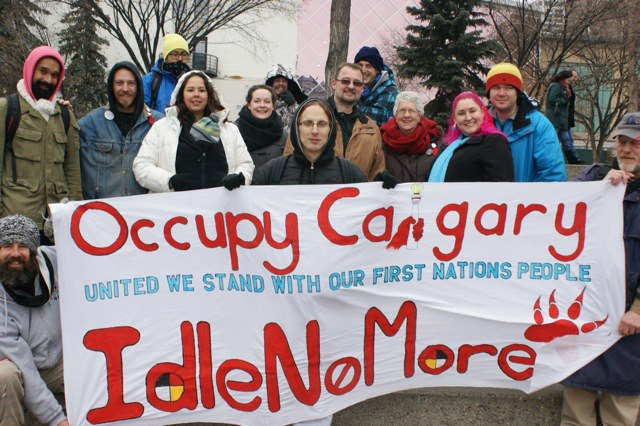
Make no mistake, the prime movers of this “Idle No More” thing are the same clowns who pulled the “occupy” thing last year. Below is them with a banner they giddily prepared last weekend in preparation for next week’s event.

There is no need to try and hide behind a false Charter right for people to break the law while expressing themselves. We wasted enough court time proving that such a right does not exist with “occupy” and the injunctions served across the country. The provision of the Charter below makes it pretty clear:

1. The Canadian Charter of Rights and Freedoms guarantees the rights and freedoms set out in it subject only to such reasonable limits prescribed by law as can be demonstrably justified in a free and democratic society.

Keeping people from blocking vital infrastructure and trade is a reasonable limit. People may legally demonstrate all they like as long as they do not impede upon others. So far “Idle No More” appears not to be interested in remaining legal and precedence has been set allowing them to break the law already unfortunately.

I very much expect Calgary’s Police Service to ensure that all laws are followed next week.

Otherwise citizens of Calgary may feel compelled to take things in hand ensure our laws are abided by. That would be a shame considering how much we spend on law enforcement.


By every measure the Canadian reserve system is an abject failure.

For decades Canada has been doing everything possible to try and repair the grossly broken native reserve system. Every year expenditures directed to reserves are increased by all levels of government. Veritable armies of consultants are sent to reserves to improve conditions. Summits, conferences and special events are held constantly trying to address challenges on reserves in Canada and academics churn out endless long-winded but hollow papers expounding on how reserves are essential to the well being of natives in Canada.

Despite all of these efforts, the socioeconomic misery of native reserves continues and is actually growing worse. Hundreds of thousands of people are living in misery on these race based enclaves with utterly no sign of relief in sight.

When will it be time to face reality and accept that the reserve system itself is a total failure? How much more time will we let pass before coming to this general realization? How much more suffering has to happen?

One of the main things that has neutered politicians and the press alike has been the tactic utilized by people invested in the status quo of labelling all who criticize the system as racists. The tactic has now been so overused that it really is beginning to lose effect. True native leaders are beginning to surface and seek systemic change and self-serving activists like Pam Palmater & Theresa Spence are finding themselves delegated to the sidelines due to their own extremism

I am going to list the stats below that clearly demonstrate the catastrophic failure in the system. It is not racist to do this. I am not claiming these stats are like this because of the shortcomings of a race. These stats are like this due to people living in the apartheid system of racial segregation that we call reserves. Any race would be dysfunctional in the circumstances that reserve-born people find themselves in under the Indian Act.

Please look at those stats and honestly try to think to yourself how any of them will change in the current system. We can do some things to ease these issues, but as long as we have a separate class of people segregated racially and living under different set of laws, these conditions simply will not change.


The stats below came from here.

 HEALTH

Healthcare is always a dominant issue in Canadian politics. It is cliché but true that if you don’t have your health, you truly have nothing. While supporters of the status quo love to quote a discredited study showing apparent increased cancer rates among natives near oilsands areas, they neglect to mention that natives on reserves suffer from higher cancer rates on pretty much every reserve in Canada due to lifestyles that create health problems.

Teams are sent to reserves and health education programs tailored to on-reserve natives are myriad. Despite that, the health issues and challenges faced by reserve dwelling natives are untenable.

While over 76% of Canadians are non-smokers now, only 41% of natives on reserve are non smokers.One doesn’t need to be a doctor to see how this increases cases of cancer on reserves.

Drinking and other substance abuses are well above and beyond those suffered by off-reserve citizens.

Obesity rates are more than double that of off-reserve Canadians. This leads to all sorts of complications such as diabetes and heart disease.

Suicide rates among native youth are 5-6 times that of non-native youth.

All of these factors among others lead to a general and unacceptable gap in life expectancies between natives and non-natives.

In 2000, life expectancy at birth for the Registered Indian population was estimated at 68.9 years for males and 76.6 years for females. This reflects differences of 8.1 years and 5.5 years, respectively, from the 2001 Canadian population’s life expectancies.

Many health issues are related to the overwhelming poverty of residents of reserves.

Housing and poverty 

Housing is a chronic issue on native reserves and I have written on why it will never improve in the current system here.

Members of the Indian Industry and others who personally benefit from the current system keep insisting that if we simply increase expenditures on housing that problems will end. That has been proven wrong so many times that it is depressingly laughable. The capacity to absorb resources for housing on reserves is infinite.

Davis Inlet was a perfect and prime example. Like so many reserves, Davis Inlet hit the wall and hit an untenable wall of substance abuse and housing shortcomings. At a cost of $200 million the entire community of a few hundred people was moved to a brand new location.  Despite that move, the issues remain and continue in the town’s new location. It is the system, not the lack of expenditures that is destroying these people!

Native housing falls below normal standards by every measure.

Sewage, water and emergency services all fall short on reserves despite money spent as well.

Generating local taxes on reserves is one idea but with the appalling differential in income between on and off reserve natives, it simply will not work. The money is not there.

Education 

Education is often and correctly pointed out as a means to ease native poverty. Despite this knowledge, despite extra-spending through scholarships, grants, affirmative action in post-secondary institutions and countless other native education plans and programs, the outcomes simply are falling short.

Just over a third of reserve residents manage to even graduate high-school.

The inspiration to pursue education simply is not there for a dependent people who see no future for themselves no matter how many opportunities are presented.

CRIME

 As can be seen below, crime rates are incredibly higher on reserves as compared to off of them. Much goes unreported of course in cases of domestic abuse and animal cruelty that are difficult to monitor. What do we expect with people locked into isolated locations of poverty and misery?

Criminal Code incidents reported to police on-reserve, 2004 
Location of incident
On-reserve Outside reserves
Number of incidents Rate per 100,000 population Number of incidents Rate per 100,000 population
Homicide 41 13 581 2
Attempted murder 24 7 693 2
Robbery 162 50 27,315 93
Assault 20,804 6,464 225,843 770
Sexual assault 1,694 526 21,840 74
Other sexual offences 123 38 2,502 9
Abduction 30 9 605 2
Total violent crimes 22,878 7,108 279,379 953
Breaking and entering 7,276 2,261 267,441 912
Motor vehicle theft 2,887 897 166,657 568
Theft over $5,000 257 80 17,037 58
Theft $5,000 and under 7,586 2,357 673,299 2,297
Possession of stolen goods 594 185 34,806 119
Fraud 691 215 96,400 329
Total property crimes 19,291 5,994 1,255,640 4,283
Prostitution 9 3 6,484 22
Gaming and betting 2 1 191 1
Offensive weapons 1,289 400 16,713 57
Arson 603 187 12,545 43
Bail violations 5,337 1,658 98,997 338
Counterfeiting currency 282 88 159,607 544
Disturbing the peace 13,721 4,263 103,301 352
Mischief (property damage over $5,000) 810 252 11,836 40
Mischief (property damage $5,000 and under) 15,990 4,968 325,025 1,109
Other 12,883 4,003 209,047 713
Total other Criminal Code offences 50,926 15,823 943,746 3,219
Total Criminal Code offences 93,095 28,925 2,478,765 8,455

Increased law enforcement will not ease this epidemic of crime. Natives are already hugely over-represented in our justice system. Again we have to change the system rather than trying to patch the current failing one.

We often hear of people trying to claim that we need to maintain the reserve system in order to preserve native culture. As with so many things, that is failing dismally. Language and cultural practices are vanishing  quickly on reserve. When one starts looking into the more accomplished native artists and performers out there, they will invariably find that most of those people have left their reserves or were never on one to begin with. As has been said before; poverty will kill culture far faster than prosperity ever will.

Do Chinese Canadians need utter separation from society in order to retain their culture? Jamaican Canadians? Ukranian? Of course not.

Ending the reserve system is not cultural genocide nor assimilation!

I really get tired of idiots perpetuating the crap above. Cultures flourish all around the world without segregation and native ones can and will too. The current culture being fostered on native reserves is simply one of dependency and misery. Hardly a reflection of some kind of noble past culture that some naïve academics and activists appear to envision.

Nobody can honestly look at the trends and numbers with regards to the Canadian reserve system and claim that it is sustainable or even humane. It is a catastrophic failure being held together by the racist Indian Act. We need to work to get away from both the Indian Act and the reserve system as it stands or things will only get worse for everybody concerned.

I understand that we can’t simply end these sorts of things overnight. Until we set ending the system as an end goal though, all we are doing is futilely trying to fix a system that needs ending rather than repair.

I look forward to informed and realistic discussions seeking ways to end the cycle of misery that we have in Canada with the reserve system under the Indian Act.

Free enterprise will ease native reserve dependency if we would let it.

I am happy to see Canadian native issues remaining on the forefront of public discussion despite the idiocy coming from some Chief’s, activists and politicians who have jumped onto the whole “Idle No More” movement. While the “Idle No More” crowd is demonstrating great discontent, they really are proposing utterly nothing in the way of solutions to current problems on reserves across Canada, in fact the “Idle No More” bunch has not even really accurately been able to point to the source of the problems. We hear buzz-words and see indignant rage but we really see nothing of merit coming from the demonstrations and illegal blockades being fostered by this movement of activists.

The only thing the thinking public at large really shares with the “Idle No More” movement is the knowledge that current conditions on native reserves are simply no longer acceptable. Productive discourse is quickly lost with most activists as they bleat out loaded terms such as “genocide” and “assimilation”. We can’t reason with stooges who are threatening such actions as “shutting down the Canadian economy” or “activating warriors” either. To get productive discussion on native issues one has to shut out the white noise from the self-serving activists such as Chief Theresa Spence and the ever self-serving Pam Palmater and speak with rational people.

One of the main contributors to native misery is dependency. Dependency damages the pride and sucks the self-worth from an individual and is the chief factor in the outrageous rates of suicide, substance abuse and domestic abuse. There are few ways to destroy a human more effectively than to make them feel directionless and without purpose and dependency fosters and maintains both of those destructive feelings with terrible efficiency.

For most reserves, a person who is tired of depending on the welfare of others does not have the simple choice of going out and seeking a job in the pursuit of personal independence. Most reserves are not near major centres of employment and unless a person has close connections to the Chief and Council on a reserve, they likely will not find employment with the band itself. If reserves and individuals are ever to see fiscal independence and sustainability it will have to be through creative free enterprise. Only through development of reserve based businesses will we see at least some easing of the dependency that is a factor in the vast majority of reserves in Canada.

Simply stating that free enterprise will free reserves from dependency is not enough. Starting and maintaining a successful business is a difficult and potentially terrifying exercise for people native and non-native alike. Natives entrepreneurs face some challenges that non-natives do no have to deal with and I suspect that many people do not realize. Many government grants have been almost blindly thrown at reserves in the hopes of kindling active enterprises but the failure rate of those ventures has been catastrophic for a number of reasons.

Fiscal independence alone is not what is needed on reserves. If money alone could ease things, the Samson Louis-Bull reserve in Alberta would be doing great due to decades of massive oil and gas revenues. The town of Hobbema on that reserve is awash in social discord, poverty and gang violence giving it one of the highest murder rates per-capita in North America. Reserves need fiscal independence but they need the independence built from within in a participatory manner. That builds the pride and social structure that leads to social stability.


Native reserves are loaded with ambitious and creative citizens who would love nothing more than to start a business. There are countless ideas and concepts that would take off if given the proper chance and with the proper support. Many keep thinking that the only support required for such things is in the form of a government grant. The issue is much more complex than that but there are solutions and the payoff for everybody can be great if we can remove some of the roadblocks to native enterprise.

Last fall I attended the second annual Aboriginal Entrepreneurial Conference and Trade Show in Ottawa. In a shameless plug for the family business, I am including a picture of myself manning the booth at our conference display (if you ever need a good deal on ammolite gems, send me an email). The conference was an excellent networking opportunity for everybody and there were some excellent breakout seminars full of information on how to create successful native ventures. There was a great deal of informal discussion among those of us in attendance too and the subject of the special challenges to native businesses came up often. I am going to list below some of the prime hindrances to native enterprises and how we must remove them.

 

Bureaucracy and Corruption

While bureaucracy and corruption are two different things, I am including them together here as both of those things are tightly tied in native politics and business.

Red tape has killed countless ventures since the beginning of time. In native politics, corrupted red-tape has been brought to a whole new level of art-form. Parasitic members of the Indian Industry from lawyers to band employees to federal employees to council and chiefs to all sorts of consultants have been drawn like flies to poop as they see opportunity to line their pockets through the bureaucracy of reserve business applications. When a reserve citizen wants to start a venture, applications suddenly become mountainous. Consultants seem to spring from the woodwork who offer to ease the paper process when they actually have every interest in expanding the process while bleeding the applicants dry. It is almost standard practice in many (not all by any means) that the Chief and Council will be paid if not outright, then through token salaried positions to them and their families. Many many ventures of great promise have died before even beginning as their founders lose hope in the maze of corruption and bureaucracy that gets dumped upon them. To refuse to play the game is to have applications forever dumped on yourself and a never ending stream of demands for more studies and reports at great cost. To rebel on the more corrupt reserves could even mean losing one’s house if the Chief and Council are annoyed and unprincipled enough.

The prime employer on reserves has been the band itself for decades and decades. Bureaucracies can only grow as band employees generate ever more regulations and forms to try and justify their positions. If any municipality ever had to deal with the overmanagement of a native band, every business in the municipality would go broke within months. Even non-corrupted reserves still choke and kill ventures with their overbearing processes.

Cleaning up the corruption on the band management level begins with transparency. The reason that many of the Chiefs in Canada are up in arms right now is because Harper is bringing in transparency legislation that will expose many of their inept and often corrupt practices. These legislations must pass and self-serving people such as Chief Spence and her band manager/common-law husband must be exposed to the membership of the reserves. When the corrupt are dislodged, streamlining of band management and process can happen.

Indian affairs is loaded with all sorts of bureaucrats who strangle ventures as well. Every level of native management from band level to federal departments needs to be examined and cleaned up. Until that happens, business development will continue to be stunted on reserves.

Reserve Isolation 

Chief Clarence Louie is without doubt one of the brightest and visionary of Chiefs that Canada has seen in generations. Louie’s management of his Osoyoos Band has been incredible in both the changing of band attitudes to the pursuit of successful business ventures. To be fair though, Louie has enjoyed a geographic advantage that many other reserves do not have. Osoyoos is accessible and has a great climate. We can’t expect isolated Northern Canadian Reserves to be able to set up vineyards, wineries, casinos and golf courses as Osoyoos has. This does not mean that those reserves have no opportunities though.

Modern communications now provide incredible new opportunities for isolated reserves. Products, services and attractions can now be marketed in ways that were outright impossible only 15 years ago. Many reserves are placed next to some of the best hunting and fishing areas in the world and native guides for such activities are incomparable in their skills and local knowledge. Many people are more than willing to pay a great deal of money to experience natural activities on reserve lands. Hiking, camping, photography or simply experiencing local culture can draw many people and provide all sorts of local jobs on reserves. The means are now there for reserves to reach out to the world and show what they have.

Genuine native artisan products are always high in demand and reserves boast many incredible artists. Now middle-men and distributors can be cut away as products can be marketed online and shipped directly from reserves to customers.

There are doubtless many more creative ideas and ventures than I can think of that are now potentially feasible on reserves and I am sure many reserve citizens are ready to move on them. It will take training and time though. Simply having access to the internet does not mean a person knows how to utilize it to aid in their business. Literacy programs such as the Harper one and conferences such as the one I attended last fall are the sorts of things that will lead to more reserve citizens taking advantage of the opportunities that modern communications now provide them with.

We need to expand education for aspiring native business people with a more practical curriculum. Liberal Arts are fine and dandy but they won’t teach a person how to manage a promotional website, how to create a business plan or how to effectively market in general. These critical things need to be taught through mentoring and conventional education.

It has to be noted that educational efforts still have to be tailored carefully to take the special circumstances of people from isolated reserves. We can’t simply take somebody from a small and isolated community and drop them into a university in an urban area. The social adjustment could very well destroy the efforts of the individual to get an education as they retreat to the reserve dejected and defeated. While some individuals could integrate perfectly fine in such circumstances, some others will need a differing program. Distance education utilizing the internet provides great options to help with this too. While specially designed programs and the logistics may make these educational efforts costly, the benefits will far outweigh that if we see some independent businesses beginning to set up and remain sustainable on reserves.

Social Challenges 

There is a term I often use called “crabbing”. It is part of an analogy where if you use a bucket to keep crabs in. One crab on it’s own will climb out and escape. If you have multiple crabs none will escape as whenever one tries to climb out, the others will pull the ambitious crab back down to themselves. This syndrome is not at all unique to native reserves but it is more acute due to them often being small and tight knit communities with unfortunately a myriad of socioeconomic problems.

An ambitious person’s efforts can often make less ambitious person uncomfortable as it exposes their own shortcomings to themselves. This often inspires a person to try and drag the person back down to their level. Any successful business person native or non-native will relate about the naysayers who they had to overcome when they began their venture. Many people had to change their social circles to avoid being brought down before they got going. This option of change is simply not available to reserve citizens where social standing is very important and it is not as if there is a number of social circles to choose from. The people bringing the ambitious down are not bad people, they are just troubled people. No native business person is going to shun the family and friends for the sake of their venture so help in coping with some of those challenges for the aspiring business person is vital.

This whole challenge is complex but very real. The simple words “So what, you think you are better than everybody now?” can be terribly cutting and defeating. It will take a cultural shift that celebrates individual success in order for this challenge to fade and that may take generations. For now, native business people need to be coached and encouraged and learn to shake off the naysayers. It is tough but it can be done.

Another challenge comes from off-reserve and it often stems from non-native activists who seem to equate reserve independence with assimilation. These people seem to want to keep these little isolated reserves like zoos where things never change and some sort of hunter gatherer society will re-emerge and thrive if we just keep pouring enough money at it. I saw this attitude greatly as activists stacked hearings for the Mackenzie Valley NEB and Joint Review Panel pipeline hearings. These union funded urban dwellers would wax on about how an influx of money and workers into the Northern communities would destroy culture. I assure you, poverty and dependency are destroying culture on reserves far faster than prosperity ever could.

Lets be clear; the natives of old were among the most independent and self-sustaining people on the planet. It took tough, creative, hard working people to thrive in Canada’s environment hundreds of years ago. The perpetuation of dependency is not how that native strength of independence and culture is going to thrive. Modern times are here. There is a new way to personal independence and it does not mean one is shunning their culture, they are simply evolving. Successful native business people are not “apples”, they are simply creative hardworking people. The outsiders insisting on shielding native reserves from modern concepts must be ignored. Latte-lapping academics and hipsters really don’t know a hell of a lot about reserves no matter how many letters are next to their names on their business cards. Just as going to Mardi Gras for a weekend does not teach one what it is to be Cajun, attending a Powwow or occasional sweat does not imbue much insight to day to day reserve living.

Financing 

Lack of property is the main and critical hindrance to many native businesses. Due to communal property on reserves, native entrepeneurs can’t build the collateral required as easily as non-natives do. Unsecured credit is difficult for anybody to aquire and it is pretty much impossible for an ambitious native who has never had a job opportunity in order to create a credit rating. Credit is needed for seed capital as well as operating funds. Ordering supplies and making payroll are things that require short-term credit in even the most thriving of businesses. Native business people are terribly handicapped by this circumstance.

One way around this has been through partnerships with interests off reserve. This can work well but is often still hindered by challenges from bureaucrats both on and off reserve. Negative experiences with band business ventures has made many businesses shy away from dealing with reserves over the years too. It will take time and examples of success in order to see more trust build and relationships grow in more joint-ventures. For larger ventures though, partnerships are an excellent route to go as outside interests not only provide funds, they provide experience and mentoring as well. We need to open the path to more of these relationships.

For smaller operations such as artists or lone guides, partnerships are not really an option though the need for financing and training are just as acute as with large ventures. Government backed loans and grants can help but they have a terrible default rate with native ventures unfortunately. The best model for native small business owners would be the acquisition and growth of their own net fiscal worth so that they can build collateral to fund their ventures. Few things inspire an entrepeneur better than putting their own hard earned nest egg on the line for their business. Sure, some people will lose at times. That is the hard nature of business. Some will thrive too and that is what makes it worth it. Blank cheques never lead to future independence.

The activist element and the parasites in the Indian Industry oppose property rights for natives fervently. That opposition alone makes it clear that it is the way to go. Individuals need empowerment on reserves and only through the ownership of property that they have full title to dispose of at will will we see sustainable reserve life grow. Pride and personal estates can grow through property on reserves just as they do off reserves. We need to win the battle to instill those rights for reserve citizens though and it is going to be hard fought.

There is a world of potential on native reserves. These reserves can thrive and prosper if we can shed the myths and trash from the supporters of this status-quo of misery and poverty. Ignore those howling about mythical treaty rights violations or entitlements due to the actions of ancestors. Set aside the activists and the self-serving Chiefs who want to maintain their personal fortunes. Free enterprise on reserves is not a panacea but if allowed to thrive it will at least ease the dependency on some reserves while eliminating it on some others. There are some steps that will need to be taken before this can happen though and I hope that the public begins to discuss, examine and then pursue these changes that we need.

I have been rather rough on some and should clarify; not all band Chiefs, councils, bureaucrats, consultants and employees with Indian Affairs are inept or corrupt by any means. There are some very dedicated people working as hard as they can in all of those categories. Their efforts far too often are encountered by the inept and corrupt who do infest their circles however.

Let’s put the whole “sovereign nations” idea to rest and have some real discussions.

I truly am happy that the “Idle No More” protests have brought discussion of native issues to the forefront in Canada. Our biggest shame as Canadians is our racially segregated native population living in economic and social misery in our appalling reserve system under terribly outdated and racist legislation. We need serious discussions as a nation as to how to end this cycle of misery that appears to get worse year after year no matter how much time and resources are being dedicated to it.

While “Idle No More” can be credited with engaging the national discussion, credit to the movement for anything productive pretty much ends there. “Idle No More” began with modest and well meaning intentions but quickly was taken over by extreme activists both native and non-native who sound pretty much like last year’s “occupy” movement in their lack of focus on anything specific aside from a general loathing of the Harper government and capitalism in general. That would be of course because the same unions and activists that led “occupy” have deeply entrenched themselves into the “Idle No More” movement and soon they will doubtless kill all credibility in the movement before moving back into their urban lifestyles.

In native politics there are a few elements of people. There are your average reserve level natives who are simply trying to get by as they are challenged by the poverty and dependency that are inevitable in our system of racial apartheid. We rarely hear from these people as they are rather busy and disengaged as they are awash in the socioeconomic mess of reserve life. These people are often used for photo opportunities by the activist elements who like to point to poor conditions on reserves as a means to attack our current federal government. To be fair, those images are used on occasion by truly racist people to try and paint natives as being from some sort of inferior race incapable of taking care of itself. It is the circumstance, not the race that is the problem here. People of any race would be dysfunctional raised in reserve circumstances.

Band Chief’s, councils and hired administration are another element of native politics. The degree of competence and ethics practised by people on this level of native politics varies widely as there are 600 bands on over 2000 reserves in Canada. While some Chief’s, councils and administrators truly have the best interest of the native residents under them at heart, corruption and mismanagement are epidemic in native reserves in Canada. Theresa Spence’s gross mismanagement of Attawapiskat is only unusual in the amount of attention that it has garnered. There are hundreds of reserves in Canada is much the same condition and for the same reasons.

The next level in native politics are the members of the “Indian Industry”. The most abhorrent of people take part in this portion of native management. There are levels and levels and levels of bureaucrats and consultants in this industry and they are accomplished parasites at intercepting government dollars before they ever come anywhere close to the natives on the ground who need them. Within the industry are countless lawyers as well who bleed the system dry with endless litigation on issues of questionable merit regarding native issues. A lawyer can make a good pocket full of cash going to court on a treaty interpretation issue no matter how inane it is as government will foot the bill for the action win or lose. If we want to see resources efficiently getting to where they belong, this cottage industry of bureaucracy and corruption needs to be cleaned right out.

We next get a level of activists in the native world. Many of these folks are non-native but have taken it upon themselves to focus their activism on native issues. Many of them envision themselves as some sort of reincarnated natives in white bodies though and it is comical watching them assume and wear items of native regalia. There are natives in the activist end of things as well of course. Lately one of the most shrill has been Pam Palmater who failed in her bid for the leadership of AFN and now has placed herself at the head of the “Idle No More” group. Palmater almost rages when speaking in her self-styled role as representative of “Idle No More” but despite her passion she seems to fall short on proposing anything aside from anger and perpetuating myths. It is from the activist bunch that we see many of the counterproductive ideas and myths erupting that ruin good discussion of native issues.

What the native activist world is constantly pushing for is all of the authority of native self determination while eschewing all elements of responsibility that come with that. Native activists are fight tooth and nail against forms of government oversight of the management of native bands yet howl indignantly while blaming the government when we see cases of massive mismanagement such as with Attawapiskat. You simply can’t have it both ways. Funding without oversight has turned native affairs into a giant black hole of expense with no visible or tangible benefits to be seen. Despite massive injections of money, traditional culture on reserves is fading and poverty is epidemic. Only through some forms of accountability will this trend change and it will take outside management to do this. This is not being paternalistic, this is being realistic.

The activist element constantly claims that we must abide by treaties until somebody actually points out what is in the treaties. Upon realistic exposure of treaty obligations the activist element suddenly goes off into an unverifiable and essentially fictional world where we must now suddenly abide by the spirit of treaties that only they of course can interpret.

One of the most deceptive and to be honest, ridiculous assertions by the native activist element is that native bands, tribes etc. are actually sovereign nations. It is through this imaginary status that activists try to play every possible side of the fence whenever they please. Again, these people want to pursue all of the autonomy of action of independent states yet they refuse to accept all of the responsibility that would come from such a theoretical setup.

A list of sovereign nations can be found here: http://www.nationsonline.org/oneworld/states.htm One may note that there are no native bands listed there. I spotted no Mauri or Australian aboriginal nations in that list either. That of course is because these groups are not sovereign nations.

Sovereignty and nationhood can be very ambiguous things to define and wars have indeed been fought over such interpretations. It is simply absurd to recognize native bands as such but let’s go down the road of what commonly would be expected of a sovereign nation by most people’s measures.

Native sovereign nations should be expected to collect their own taxes, create their own currency, come up with a passport/visa system for citizens to come and go, develop their own resources, build and maintain their own infrastructure, make independent trade deals with other countries, make their own constitutions, make their own laws, make their own police forces, armies and courts…… The responsibilities go on and on and on. Clearly this is NEVER going to happen so lets move conversation to reality shall we?

At a website of Ontario Chiefs  I see some of these wonderful statements built around that flawed sovereign nation concept too. While never addressing possible fiscal independence, it demands a right to all authority in governance and their site says this:

“As sovereign Nations we have never surrendered our rights or title in right of the Crown or the successor state of Canada but, have maintained and solidified their inherency (sic) through the Treaty making process”

The above statement is false on two levels. They are not sovereign nations and they indeed fully ceded title and rights to the crown when signing treaties. While some treaties have elements open to interpretation of intent, the ceding of land and title is pretty clear as per this clause from Treaty 9 below for example:

“For the purpose of negotiating an extension of James Bay Treaty No. 9 with the Ojibeway and other Indians, inhabitants of the territory within the limits hereinafter defined and  described, by their chiefs and headmen, for the purpose of opening for settlement, immigration, trade, travel, mining and lumbering, and for such other purposes as to His Majesty may seem meet, a tract of country bounded and described as hereinafter mentioned, and of obtaining the consent thereto of His Indian subjects inhabiting the said tract, and of arranging with them for the cession of the Indian rights, titles and privileges to be ceded, released, surrendered and yielded up to His Majesty the King, and His successors forever, so that there may be peace and good-will between them and His Majesty’s other subjects, and that His Indian people may know and be assured of what allowances they are to count upon and receive from His Majesty’s bounty and benevolence, which said territory may be described and defined as follows, that is to say the said treaty to release and surrender also all Indian rights and privileges whatsoever of the said Indians to all or any other lands wherever situated in Ontario, Quebec, Manitoba or the District of Keewatin or in any other portion of the Dominion of Canada.

As I said, we need this discussion of how to deal with the growing disaster that we call a reserve system. These discussions must be based in reality and facts. As per past blog postings of mine, I have asserted and still believe that most people who are advocating for treaty rights have never actually read the treaties and don’t really know what they are asking for. Treaty 9 calls for compensation of $4 per year per Indian. Even adjusted for inflation that isn’t very much. There is nothing about healthcare or housing or many of the other things some are claiming as treaty rights.

It may be noted that while that group of Chiefs constantly states that FNs have some sort of inherent authority to all elements of their own governance, it says nothing about ending the utter dependency upon Canada for funds. Sovereign means independence in more ways than simply self-determination and sustainability of a modern economy on most of the reserves in Canada is utterly impossible.


Lets begin with what is documented in the treaties and work from there rather than with the myths and false interpretations coming from the self-serving native activist network. When we do that, we can start moving towards some real changes that may benefit future generations of natives and non-natives alike. Getting hung up on crap such as sovereign nations existing within nations is simply distracting and counterproductive.

We have an opportunity to seek and discuss solutions to this wretched and untenable system of racial segregation through reserves in Canada. I hope we are ready to take it on with reality and facts as a basis. We need to cut through the white-noise of activists and self-serving people entrenched within the system and start to look towards what will really aid the natives suffering on reserves in our current system.

Let’s look at these isolated reserves and try to envision what they will look like a in ten years, twenty years and fifty years from now. When looking with the status-quo in mind, we see only more misery no matter how much is spent.

Barrage of information.

Well it has been an interesting week since I posted here and began asking on social media “which treaties are being violated?”

You see, there is a myth being perpetuated in Canada that somehow native treaties are being breached or are soon to be breached by some new legislation. While some native activists and indignant hipsters have almost been chanting and screaming that treaty rights are being violated; not a single one to date has been able to point to a direct violation.

I have tried to make things as easy as I can. I posted links to all the treaties (very straightforward documents) and invited people to read them and point out where violations are happening.

Since asking those questions, I have been called a moron, uneducated, stupid, uncaring, evil, heartless, despicable, and of course I have been called a racist many times. Somehow I have also been accused of being a Christian fanatic and somehow a homophobe out of all of this too.

I am not sure how simply asking a question makes me any of the above things. What I think is that I have hit the issue on the head. People have not read the treaties and upon being asked they respond by attacking rather than admitting that the breach in treaty rights that they have been claiming simply does not exist.

People have also tried to sidetrack. I have been dragged down discussions on the Charter, the Constitution, the United Nations, the Indian Act and even somehow the Magna Carta. I was sent links to open letters and blogs claiming treaty violation without specifics. Still, nobody could point to a simple ongoing treaty violation.

The closest I saw to a contemporary treaty breach was a link sent to me to this site where it appears that there has been some land allocations of the past that were miscalculated making a breach in some treaties. As can be seen though, it is being addressed efficiently. No mad breaches in rights or need for hunger strikes.

What is great with today’s information age is the ease with which one can dispel myths and untruths. Only 15 years ago it was damn near impossible to simply counter a person’s false claim that treaty rights are being violated. I wouldn’t have even known where to begin to find a treaty in it’s original and full text. Now with a few minutes on google the documents can be found in full and the facts exposed.

The downside of the fast exchange of information is that myths and untruths can be spread more quickly than ever too.

Normally I would not pay much attention to the vapid, profanity laden ramblings of a young shallow urban dwelling lady like Natasha Hynes that are in the video below.

One really does not have to listen long to see that this young lady has nothing much to add to political discussion aside from simplistic repetition of statements on treaties and a blistering number of swears. What is disturbing though is that in a short time apparently nearly 70,000 people watched that video.

VIDEO BELOW NOT SAFE FOR WORK!

It can’t be assumed that all of those watchers checked Natasha’s broken facts and sadly a myth spreads even further.

To counter Natasha’s ill-informed rambling, we have the blog: A Bear’s Rant.

Bear has been hosting a series of guest postings by Peggy Tupper that I can’t suggest strongly enough as essential reading on the “Idle no more” trend. Policies, reactions and treaties are addressed excellently and the misconceptions of the moment are laid bare excellently.

The web is full of information but it is still nobody’s responsibility aside from our own to ensure that we seek facts and see through misinformation.

Social media provides us with a means to make a point using humor and simplifying things too. I made the video below to show how ridiculous Theresa Spence’s public tantrum is and to again point out that treaty rights are not being breached.

It is a simple cartoon but it makes a couple points and is free of expletives.

My challenge stands; show me the treaty violation.

No sidetracking, no namecalling. Just some facts thanks. I will make it even easier with a template:

Treaty (insert treaty name or number here) is being being breached by (insert action or legislation here) due to obligations in (insert treaty clause here).

I don’t deny for a second that there are some very serious and important issues with natives and Canada’s native policies. If we really want to address these issues though, we must stick with facts.


Let’s have a peek at those treaties.

Few things make it more clear that the usual union backed “occupy” layabouts have jumped on to the “Idle No More” native protests than hearing the vague and disparate grievances and demands being made. Problems whether real or imagined are being highlighted while no solutions are being proposed. Entitled and unrealistic demands for meetings with the Prime Minister are tossed out while uncoordinated efforts are being made to hinder vehicular traffic.

Like “occupy”, this movement is fast proving to be pointless and self-serving. The best martyr the cause can find is Chief Theresa Spence who has a rather questionable history of band management and is on a “hunger strike” which includes eating soup and other unspecified “medicines” while she refused to meet with the Minister of Indian affairs and is raising money for through her boyfriend’s account!

Really, how costly would a real hunger strike be? One would think she would be saving money.

Now a vapid call we often hear from supporters of this messed up movement is that: “We must abide by treaties!”, or “treaty rights are being violated!”

I contend that those making the aforementioned statements likely have never actually read Canadian treaties or at least really do not know what they are asking for.

The image at the beginning of this post displays all the Canadian regions under numbered treaties.

Canada’s treaties are very accessible and are actually some pretty straightforward documents. I will link to them all below and invite anybody to read them. They are all pretty similar in the obligations from both government and the natives who signed them.

Treaties 1 & 2

Those treaties demand that schools be built on reserves and that $15 per family of 5 or the equivalent in items such as twine and blankets be provided. Even with inflation taken into account, this has been provided way above and beyond treaty obligations.

Treaty 3

Treaty three provides $5 annually per head on the reserve and has some provisions for oxen. The evolution of the treaties is evident.

Treaty 4

Treaty 5

Treaty 6

Treaty 7

Treaty 8

Treaty 8 has a much improved breakdown of compensation obligations as compared to earlier ones.

Treaty 9

Treaty 10

Treaty 11

Other non-numbered treaties can be found here. They are much the same in obligations and spirit.

Noteworthy among the treaties is that they all provided clauses for possible expropriation of lands for future development if need be and extinguishment of future claims. That means that if anybody is breaking treaty obligations it is many native bands who are fighting ongoing land claims!

Here is a typical clause verbatim from Treaty 7:

“And Her Majesty the Queen hereby agrees with her said Indians, that they shall have right to pursue their vocations of hunting throughout the Tract surrendered as heretofore described, subject to such regulations as may, from time  to time, be made by the Government of the country, acting under the authority of Her Majesty and saving and excepting such Tracts as may be required or taken up from time to time for settlement, mining, trading or other purposes by Her Government of Canada; or by any of Her Majesty’s subjects duly authorized therefor by the said Government.”

Basically the above treaty clause means that government bills such as C-45 are perfectly valid as agreed to by treaty.

Do we really want to go literal with these treaties? Do we want government to simply build the odd school, provide blankets and whetstones and expropriate at will due to clauses in the treaties?

Our entire reserve system is irreparably broken and it is an abhorrent system of racial apartheid being supported by the naive and the self-serving within the indian industry. We need some serious changes and some serious discussions if we ever want to see an end to these corrupted enclaves of misery that we keep people on. The Indian Act itself is vile and should be destroyed as a document. Race based policy is only adding further damage to what older race based policies created.

Discuss the items in the above paragraph if you really want to address some issues with natives in Canada. The second you start yelping about treaty rights being violated, I have to assume that you either do not know what you are talking about or you are purposely being deceptive. Either way, that discussion will not lead to any meaningful progress on what is a complicated and terrible issue in Canada.

Treaties and government adherence to them is not the problem in Canada.


Merry Christmas!

I have never made a secret of my agnostic leanings. Due to a grog induced notion, I even have a tattoo of the Flying Spaghetti Monster who’s holy visage is pictured above.

Despite my misgivings with organized religion, I am not so insecure in myself that I have to lash out and demand that all mention and observances of other faiths be hidden from my view. I can’t and won’t be offended when somebody gives me greetings in good spirit reflecting Hanukkah, Christmas, Ramadan or Arbor Day for that matter. I enjoy well wishes from people no matter what the basis of their comment.

It all seems so simple yet so many people have difficulty with an open observance and celebration of a holiday with religious underpinnings. Every year there is some fool out there who get’s their panties into a knot over an open display of Christmas in Canada.

The myopic imbecile for 2012 is Ashu Solo who is pictured below.

Upon discovering that the city of Saskatoon was displaying the term “Merry Christmas” on their buses, Solo sent an enraged letter to city administration demanding that the greeting be removed or a complaint would be filed with the Human Rights Commission (yup, yet another wasted venture into Canada’s foolish system of Human Rights Commissions).

Solo is a known and notable idiot in Saskatoon who is chronically aggrieved. Every city has at least one (often a few) fool like him and they typically dismiss them. What was interesting though is that city administration sent a memo suggesting pulling the greetings upon Solo’s complaint. It was only upon exposure on radio host John Gormley’s show that the city of Saskatoon administration suddenly backtracked and dropped the matter upon their local council that kept the greeting on the buses.

The issue here is twofold. There are nuts like Solo who can and should be ignored and dismissed, and there are cowardly hypersensitive bureaucrats who duck and run in light of anything that could conceivably offend somebody rather that use simple common sense. It is Canada’s gormless bureaucrats who are far more disturbing and troublesome than fools like Solo.

Some make the case that if one religion’s greeting is displayed, then all religion’s greetings must be displayed. I call bullshit! Not every religion is equal in representation and not all of them need to be recognized in their observances equally by local administrations. It would be idiotic to demand that government in Iran should openly celebrate Hanukkah or that the city of Islamabad should hang Christmas lights in December. Those places will openly display whatever the majority of the people want.

To have an administration celebrate an observance that is in the majority is not an offense to the minority. I do not feel that my Pastafarianism is threatened by Christmas trees nor do I feel that the City of Calgary needs to hang lasagna noodles in City Hall for my benefit.

Christmas is a tradition and a person need not be (and many are not) Christians in order to celebrate it and enjoy it. It is by far the biggest Holiday in all of North America and that will not be changing any time soon. Those who really can’t handle that really should do some self-examination as the problem is not with Christianity, it is with themselves.

It is rarely people who practice minority religions who have a problem with Christmas anyway. Traditionally it is homegrown whitebread atheists who selectively attack the faiths of others due to some notion that it will lead to some form of world equity. It used to be yuppies and now hipsters have assumed the role. I am sure some other group of clowns will assume the mantle of indignant atheists for the next generation.

In closing, Merry Christmas and lighten up. It is an awesome holiday to brighten a long Canadian winter.

Putting money where Derrick’s mouth is.

Below is a cross-post from Joey Oberhoffner’s blog. While being a stubborn PC, he is a fine man despite it. 😉

Joey has arranged a fun little fundraiser between partisans for a good cause. Jane and I are pledging $2 per wing on Derrick as he represents the Wildrose Party.

Can we Wildrosers get a decisive win on the charitable wing/taco fundraising front?

The rest of the details are below from Joey.


Put Your Money Where My Mouth Is

Politics is ugly. It’s ugly, and it’s nasty, and it’s dirty.But it can also be a noble and uplifting pursuit, when the right people are involved.

With the Christmas season upon us, I’ve been racking my brain trying to figure out how to put the weight of our weekly pan-partisan Politweet events in Calgary behind something uplifting in time for the holidays. We certainly have a great time and learn a lot by putting away our swords and commiserating as real PEOPLE instead of as faceless partisan avatars retweeting our respective caucus communications trolls… but how do we do something that makes a real difference for someone who needs a hand up?

So here’s what we’re going to do…

My friend Shane over at Calgary Rants has been working this December to help raise funds and donations of items for the great charity Inn From The Cold. During the course of this process, he has also received a commitment from an anonymous benefactor that all donations will be matched dollar for dollar, up to $5,000. This would make a HUGE difference to the people who need to services that Inn From The Cold offers, especially at this time of year. And we’re going to help.

At the Blind Monk (918, 12th Avenue SW) on Wednesday night, Kent Hehr is hosting his regular Pints and Politics night. And at 8:00 pm, taking advantage of the fact that at least 60 politicos, if not more, will be in attendance, we are going to have ourselves a chow-a-thon. Partisans and politically involved folks from all over the province can pledge their support to any one of our designated eaters – some will be downing chicken wings, while some – myself included – will be taking advantage of “South of the Border Wednesdays” at the Monk, and will be crushing tacos instead. In the end, though, it makes no difference: While we’re competing for bragging rights for our respective parties, the important thing is that every wing or taco that gets eaten will be raising money – through your pledges – for Inn From The Cold.

We’re going to try and get at least one “designated eater” to represent each provincial party, if you define your support as a partisan enterprise. Pledges can be made in the comments section of this post, on Twitter using the hashtag “#ablegcares“, or in person at the Monk. Each eater will collect the pledges they earn, and pass them on to Shane to be matched by the anonymous donor.

Thus far, we have the following confirmed eaters – always room for more! Just email me at joey (at) dulcetmelodies (dot) ca to be added to this list! (Eaters will be picking up their own tab, unless someone volunteers to do it for them):

  • Derrick Jacobson (@AlbertaAltruist) – Representing the Wildrose Party. Will be eating wings.
  • Joey Oberhoffner (@oberhoffner) – Representing the Progressive Conservative Party. Tacos.
  • Vincent St Pierre (@vsp) – Representing the Alberta Liberals. Tacos.

The object here, folks, is to RAISE MONEY THROUGH PLEDGES for Inn From The Cold. While we’ll appreciate any cheerleading you can do in person or via Twitter, as well, we’re only actually doing any good if you can pledge. Retweet the HECK out of this post, even if you normally disagree with 99% of what I post. There’s already a commitment from Jane and Cory Morgan of $2 per wing eaten by Derrick. Surely, my PC friends can do better than that? We’re not going to let the far right walk away with this thing, are we? 😉

And not to talk too much trash, here, but I’m going to win this thing. It’s going to be April 23rd all over again. Don’t believe the polls – I was BORN for this kind of a contest. So if you’re looking at making a huge difference in the lives of some of Calgary’s less fortunate this Christmas, pledge at least $2 per taco on Joey Oberhoffner’s plate. I won’t let you down. 😉

Come on, #ableg. Let’s show everyone that when the rubber hits the road, we can do more than TALK about how to make things better. Put your money where our mouths are.


Government debt is nothing like a personal mortgage!

As the inept and increasingly corrupt Redford government marches Alberta back into debt, apologists are trying to say that government debt it a good thing and is like a mortgage. That statement is utter hogwash and it is tiring.

To begin with a mortgage is taken out by individuals (or families), to purchase what will likely be an appreciating asset. Equity (most likely) will build in the purchase that can be used to borrow against in the future in possible hard times or the home may simply be sold outright later. Barring either of the above, the home and it’s value will eventually be handed down to heirs.

Government capital projects while providing value are not typically transferable and only lead to future maintenance costs as opposed to appreciating in future value. Can we use a hospital as collateral in a future loan? Can we sell an overpass if we need extra cash? Increasing long-term value makes incurring debt for a home purchase a good idea. That growing value simply does not exist in government capital projects.

A mortgage is usually a once in a lifetime debt. People may move from home to home while building equity and transferring the mortgage but a person will generally only have one mortgage at any one time and the goal will be to pay it off. When government begins borrowing in good times as Redford plans to do now, it is akin to taking out a new mortgage every year. No appreciating asset is being purchased and debt simply keeps growing and growing. There is no equity offsetting the loan.

While a personal mortgage will eventually end, capital expenditures never will. There will always be more roads needed and hospitals demanded. Will future generations not need such expenditures too? They will have to pay for that infrastructure while paying debt off along with interest. Is this principled or fair?

We hear the dwindling Progressive Conservative supporters trying to paint things as if it is some sort of zero-sum game with idiotic questions such as: “Don’t you want schools, hospitals and roads?”. Of course we do and we will still have all of those damned things without borrowing to get them.

People keep speaking of an infrastructure deficit. By who’s measure is there a deficit? Is there ever enough hospitals? Will roads ever be wide enough? Will kids have enough schools close to home? Will there be enough libraries? The demand for spending is truly infinite. The capacity to spend is finite though and we have to draw a line somewhere.

If we need to borrow while the government is receiving record revenues as it is now, it is clear that there is no way that this administration will stop borrowing down the road no matter what energy prices do. We will borrow and borrow and borrow until an inevitable fiscal collapse that our children and grandchildren will have to endure.

All around the developed world we are seeing governments collapsing under their own debt. Most of Europe is in fiscal shambles and the USA is soon to either hit the wall or have some terribly heavy austerity measures come into place as their government debt overwhelms them. Why on earth do we want to continue to keep digging ourselves into that unsustainable hole when such clear examples of the futility of that path are in front of us?

We are lucky in Alberta to have the means for some of the best infrastructure and development in the entire world. For us to threaten this with such a gross addiction to spending and lazy government is almost obscene.

The excuses and rationalizations will be coming hard and heavy as the 2013 budget looms and Redford presents Albertans with a massive budgetary deficit. To be sure, the mortgage comparison with government borrowing is simply bunk. Be sure to remind Redford’s small social media army of that as they ramp up their unprincipled rhetoric in the next few months.